
Randolph County Projected Release Meaning
A projected date is an estimate produced from the sentence and credit information currently recognized by the responsible agency. It is not a record that release happened. In Illinois state custody, two fields have distinct meanings: Projected Parole Date estimates departure from an institution to parole or mandatory supervised release, while Projected Discharge Date estimates the end of the state sentence and supervision relationship.
Scheduled versus actual: A future date forecasts an event. Confirm release after that date through the new IDOC status, a Last Paroled Date when shown, VINE, or the agency’s institutional record.
A pretrial detainee in Randolph County Jail has no computed sentence-release date. Release depends on a judge’s order, case action, holds, and jail processing. A person serving a county sentence may have a calculable end, but the sheriff and court hold the records needed to verify it. Removal from the current jail list can also mean transfer to IDOC or federal custody.
A state profile showing an institution still indicates custody. A parole or MSR status indicates institutional release with ongoing state supervision. Final discharge is later and should not be inferred from the prison exit date.
Find Randolph County Projected Release Dates
The IDOC Individual in Custody Search is the main online route for a sentenced state prisoner. Its direct interface accepts last name, partial surname, IDOC number, or birthdate in month-day-year form. The IDOC number is the best match key. A name alone can select the wrong person.
- Open the IDOC search and use the IDOC number when available. Otherwise search by surname or birthdate.
- Compare the IDOC number, vital details, sentence data, and current location. Do not rely on a photo or name alone.
- Read location and current status before dates. An institution and a parole/MSR status describe different stages.
- Record Projected Parole Date and Projected Discharge Date as separate fields. Add the date you accessed the profile.
- Compare any Last Paroled Date or other past event field. Never rewrite a projected field as an actual release.
- If a fully discharged person is absent, contact IDOC for public historical admission, release, and discharge fields.
- After the future date passes, confirm the event with IDOC status, VINE, or an official agency record.
IDOC says its public website currently returns people who are incarcerated or on parole. It is therefore not a full historical list of everyone who completed supervision. IDOC’s main line is 217-558-2200, and its public-information or records channel can address an older record.
The captured IDOC parole profile example shows how release and projected-discharge fields appear together.
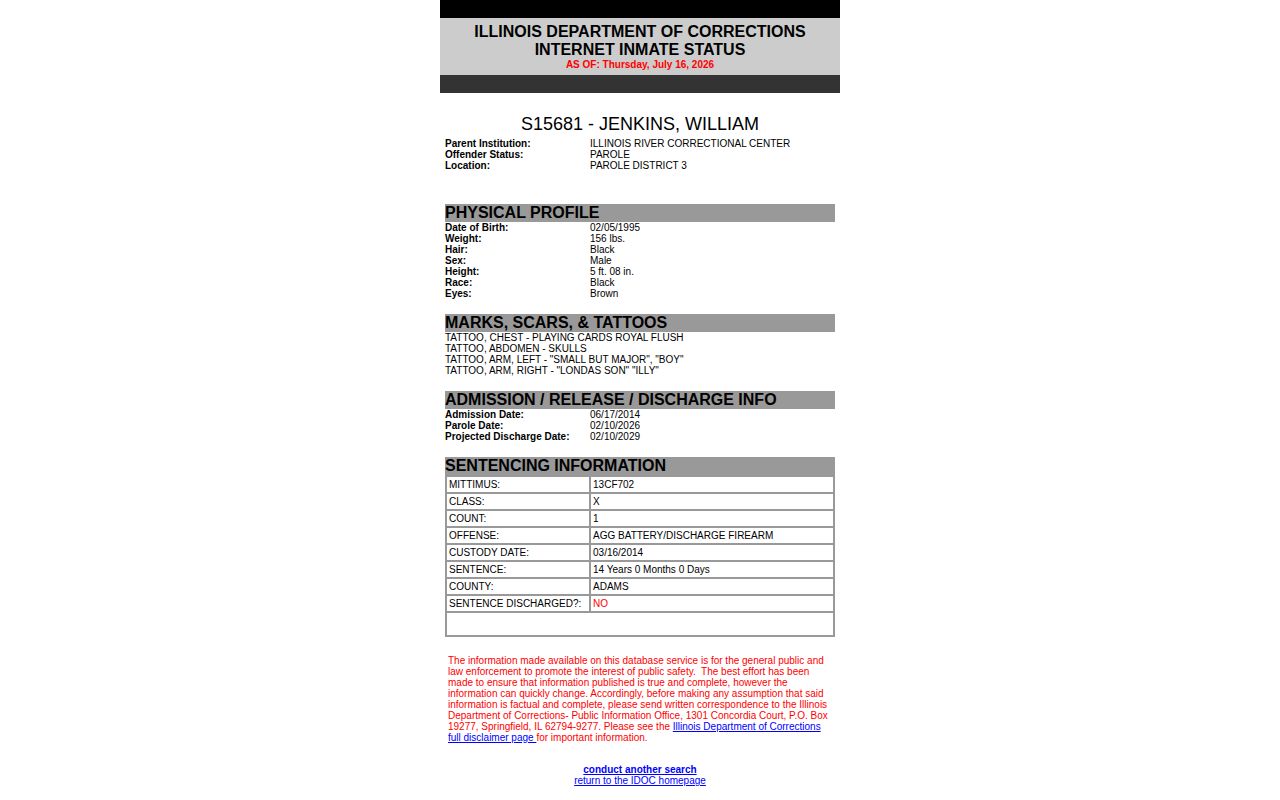
The image demonstrates field placement, but the displayed profile must not be treated as proof that a different Randolph County person has the same status or dates.
Randolph County Jail Release Dates
County custody requires a different path. The Randolph County Sheriff’s current listing shows current people, charges, photographs, and a bond column, but it does not publish release dates, reasons, destinations, or an archive. If a name vanishes, the person could have gone home, entered IDOC, remained under federal authority, or moved to another agency.
For a sentenced county-jail term, begin with the sentencing order and docket through the Randolph County Circuit Clerk. Then ask the sheriff for the booking or jail-register record showing actual release time and reason. For a pretrial case, the current court order controls whether release may occur, while the sheriff record establishes when jail processing ended.
A state-prison sentence changes the route. Randolph County roster removal at transport is the end of the county jail episode, not community release. Use the sentencing order and then the IDOC calculation. The broader Randolph County released-inmate search explains how to reconcile the jail, court, IDOC, and federal paths.
Note: A county roster date is not an IDOC time sheet and should not be subtracted from a sentence without the controlling records.
Illinois Credit for Randolph Releases
730 ILCS 5/3-6-3 is the central Illinois sentence-credit statute. It does not create one good-time percentage for every prisoner. Offense, offense date, exclusions, and sentence terms control. Its clauses include 85 percent, 75 percent, and 100 percent service rules, as well as special monthly limits and discretionary or program credit. Natural-life sentences receive no sentence credit.
The common claim that every Illinois prisoner serves 85 percent is false. A sound estimate begins with the judgment and applicable statutory minimum. It then accounts for court-awarded presentence custody credit, allowable statutory and program credit, consecutive or concurrent terms, and later corrections. A mittimus is the document that commits a sentenced person and states key sentence terms. An amended mittimus can change the agency calculation.
For many modern determinate terms, 730 ILCS 5/3-3-3(c) links service of the term, less allowable good-behavior credit, to release under the MSR rules in 730 ILCS 5/5-8-1(d), subject to the governing qualifications. The MSR period varies with the offense, date, and sentence. That is why the projected parole and projected discharge fields may be far apart.
The official Illinois sentence-credit law contains the controlling offense and date distinctions.
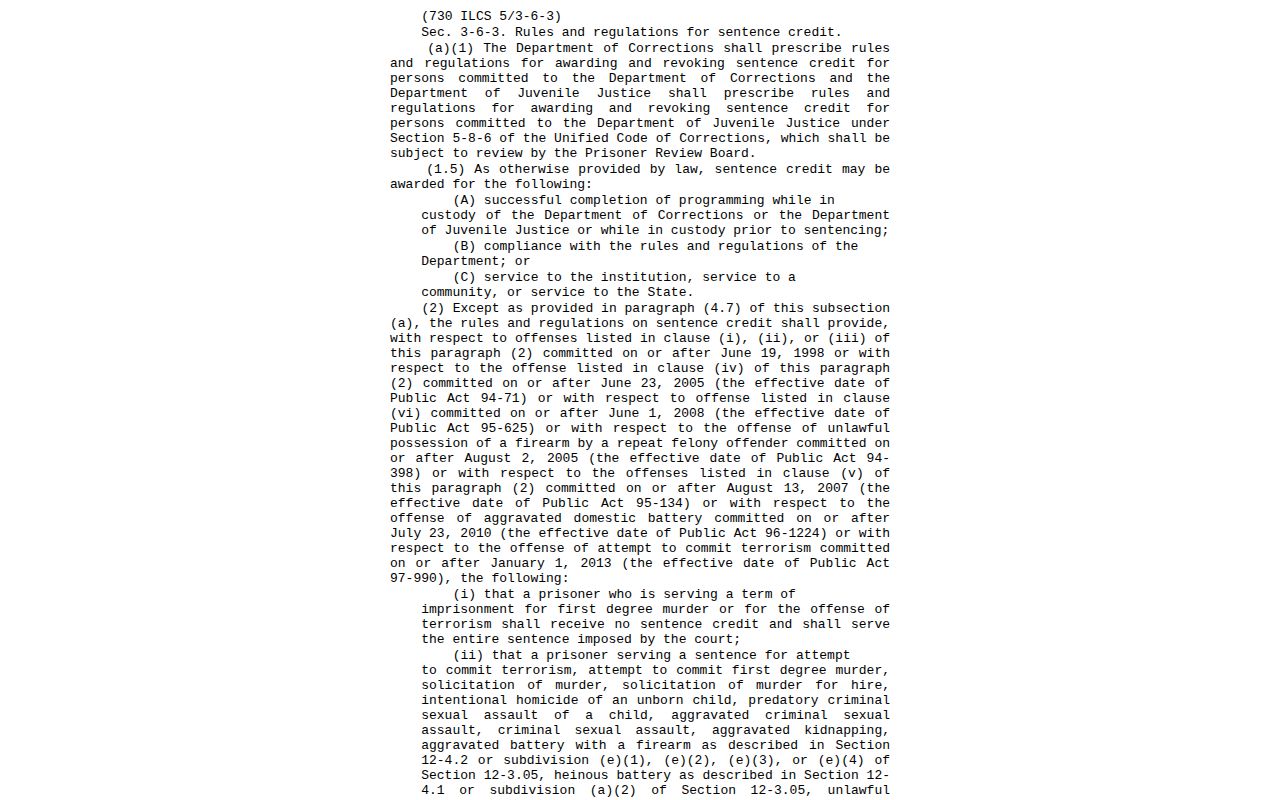
The statute should be read in its current form because amendments and effective dates can change which rule applies to a sentence.
Randolph County Earned Credit Limits
Illinois Earned Sentence Credit is a possible adjustment, not a promised award. IDOC describes up to 180 days of discretionary credit. More than 60 days served in IDOC and no statutory exclusion are baseline conditions, but they do not guarantee credit for a named person. Individual review draws on master-record information that may be confidential.
This is the distinctive Illinois computation issue behind many changing Randolph County projected release dates. IDOC cannot forecast whether or when a named person will receive the award. If granted credit revises the projected parole date, IDOC updates the profile. Credit can also be revoked or restored through the applicable process.
The IDOC earned-credit explanation describes why eligibility cannot be converted into a personal promise.
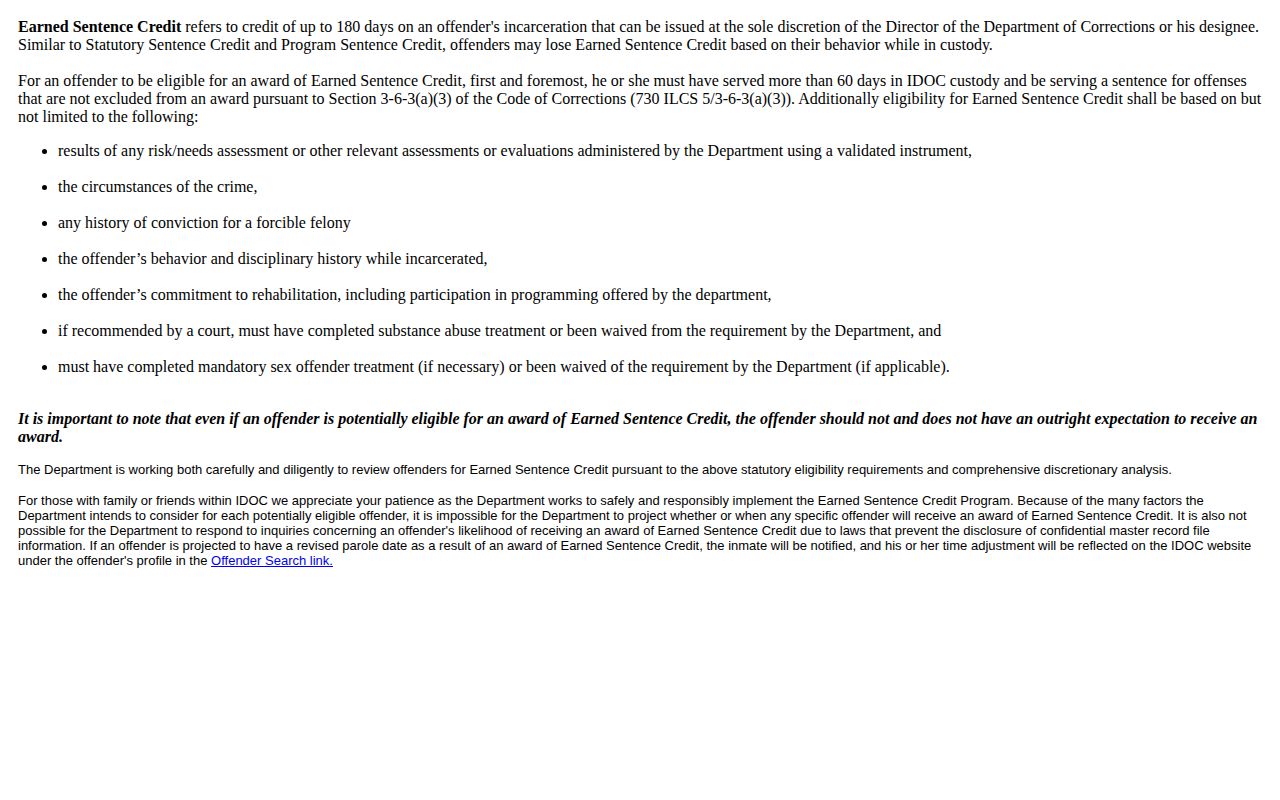
This official guidance supports checking the live profile instead of adding a possible credit award to a homemade release calculator.
Why Randolph Release Dates Change
A projected release date changes when the inputs or legal status change. Some adjustments move a date earlier, others move it later, and some change the meaning of the next event. The agency’s latest calculation is more reliable than an estimate saved months ago.
| Factor | Possible effect | Best confirmation |
|---|---|---|
| Amended court order or corrected mittimus | Changes sentence terms or recognized data | Court order and updated IDOC profile |
| Presentence custody credit | Adjusts time credited before IDOC admission | Sentencing record and IDOC calculation |
| Earned or program credit | May move projected parole earlier | Current IDOC profile |
| Discipline and credit action | Revocation or restoration may move the estimate | IDOC master record and current profile |
| Concurrent or consecutive terms | Changes how terms combine | Judgment, mittimus, and IDOC calculation |
| New case, hold, or detainer | May block physical release or continue other custody | Holding agency and court records |
| Supervision violation | May lead to return, release, or recalculated time | PRB result and IDOC update |
A detainer is another agency’s request or legal basis to hold or take custody. It can mean the person leaves one institution on the projected date but does not enter the community. Court action may also authorize release before jail processing is complete. Use exact labels such as transfer, release to MSR, or final discharge rather than the broad word “released.”
Confirm Randolph County Actual Release
Future estimates need a later confirmation. Recheck the IDOC profile after the projected parole date. A parole or MSR status and a past Last Paroled Date, where shown, support release from the institution to supervision. They do not show final discharge. For Randolph County Jail, ask the sheriff for the dated release or transfer entry and compare it with the court order.
Illinois VINE can provide a release or custody-change alert from participating agency feeds. Registration does not replace the originating record, and a transfer alert may reflect continued custody. The Randolph County VINELink check explains the one-person search and notification process. Federal and immigration custody require their own locators.
If two official sources differ, compare update times and scope. IDOC may show parole while a court case remains open. A judge may order release while another hold is being processed. Preserve the exact field, retrieval date, and source, then ask the agency that owns the disputed field to explain or correct it.
Note: Projected Parole Date forecasts institutional release, while Projected Discharge Date forecasts the later end of state sentence and supervision.