
Menard Reception Departure Outcomes
Menard Reception and Classification Center is an Illinois Department of Corrections component. It receives new state admissions and conducts classification before assignment. IDOC also identifies returned parole and adult-transition-center violators among its reception population. Because the placement is transitional by design, disappearance from reception most often signals movement within IDOC.
An assigned prison location means institutional custody continues. A parole or mandatory supervised release status means the person has left prison but remains under state authority. Final discharge is a later and distinct endpoint. The person may also be returned to supervision after a violation process, but that result must be supported by IDOC status and, where applicable, an Illinois Prisoner Review Board decision.
The Randolph County current inmate list is not the right tool. It covers the county jail, not state reception. Likewise, the absence of a person from a facility-specific page is not evidence. Use the statewide locator to find the next location, then request historical state records if the person is fully discharged and no longer appears online.
Search Menard Reception Status
Use the IDOC Individual in Custody Search. An IDOC number is the best discriminator. If it is unavailable, search by surname or partial surname, or use birthdate in the form accepted by the interface. A name match must be checked against birth or vital information, IDOC number, sentence data, and present location.
- Open the statewide IDOC search interface.
- Enter the IDOC number when known, otherwise use surname or birthdate.
- Compare identifiers and sentence data before choosing a record.
- Read current location or status first.
- Treat a new institution as transfer, not release.
- Read projected parole and discharge fields separately.
- Confirm any completed event through status, VINE, or an IDOC record.
A result naming Menard Reception and Classification Center indicates reception custody at the latest update. A later prison name establishes the next IDOC placement. Parole/MSR status supports institutional release with continued supervision. If a former person is fully discharged, the public site may return no result because IDOC says its web interface currently covers incarcerated or paroled people. Use the state records channel rather than guessing from absence.
The Randolph County released inmates page separates this IDOC route from county-jail and federal lookup paths. That distinction is vital because one person's local court case can create records in more than one system.
Menard Reception Status Meanings
The same departure can look quite different depending on the next IDOC field. Keep the location, status, and date together. A projected value is an estimate, while an actual status change supports a completed event.
| Observed result | Meaning | Best confirmation |
|---|---|---|
| Reception center still listed | Person remained in reception custody at the update. | Current IDOC profile. |
| Another IDOC prison listed | Classification ended in assignment and transfer. | Updated IDOC location and transfer event. |
| Parole/MSR status | Institutional release occurred, but supervision continues. | IDOC status, past parole field, or state record. |
| No web result after discharge | Could reflect the public interface's limited scope. | IDOC historical admission, release, and discharge data. |
| Returned violator status | Custody may relate to an alleged supervision violation. | IDOC record plus relevant PRB schedule or result. |
A VINE transfer notice is useful but does not replace the underlying state record. A court order can explain a sentence or commitment. It does not always state the exact transfer time. Each source should answer the question it was built to record.
Menard Returned Violator Records
Reception includes some people returned after alleged parole or adult-transition-center violations. An alleged violation is not automatically a new Randolph County sentence. The Illinois Prisoner Review Board handles final revocation proceedings, while IDOC records the person's custody location and calculated status.
The PRB revocation schedule may identify a facility, date, and proceeding. The revocation results page publishes dated decisions. Pair those records with the IDOC profile. A name on a schedule establishes a listed proceeding, not its outcome.
Possible final results include a finding of violation followed by return to release with or without changed conditions, a no-violation finding followed by resumed release after plan approval, or revocation followed by an IDOC recalculation. An appeal or reopening can also change the posture. Do not state that every person at reception for a supervision issue will return to prison or be released.
- Revocation
- A formal decision that supervised release is withdrawn after the applicable process.
- MSR
- Mandatory supervised release, a period of state oversight after prison for many determinate sentences.
- Returned violator
- A person returned to custody because of an alleged or decided supervision violation.
- Classification
- IDOC's assessment and assignment process for a state placement.
Menard Reception Records Contact
The reception center shares the Menard complex address and telephone. Facility staff can route an operational question. For durable proof, ask IDOC for public identification, admission, transfer, institutional-release or parole, final-discharge, and sentence information tied to the correct IDOC number.
Illinois Department of Corrections
711 Kaskaskia Street
Menard, Illinois 62259
Phone: 618-826-5071
Provide the full name, IDOC number, birthdate, and a useful date range. Ask for a transfer destination or the institutional release date that ended reception custody, as appropriate. If the agency uses a status code, request its legend. IDOC may restrict material outside its public categories, but a narrow request makes clear that the goal is to distinguish assignment from release.
Do not send an IDOC history request to Randolph County under county FOIA. The sheriff does not own Menard reception records. Conversely, a county jail booking episode requires the sheriff record even if a later state admission appears in IDOC. Keep the two institutional histories paired but separate.
Menard Reception Center Facts
The official reception and classification page describes the component's role on the Menard grounds. IDOC reported a population of 67 as of June 30, 2024 and gives an opening date in July 2004. The population figure is a dated agency count, not the present total, operational capacity, or number of people released.
The center's purpose makes its figures especially fluid. Admissions arrive for assessment, and assigned people move onward. A count on one date cannot be used to estimate releases. It also cannot show whether a named person left the reception component for another Menard unit or a prison elsewhere in Illinois.
The captured IDOC facility page supplies the official source view for the component.
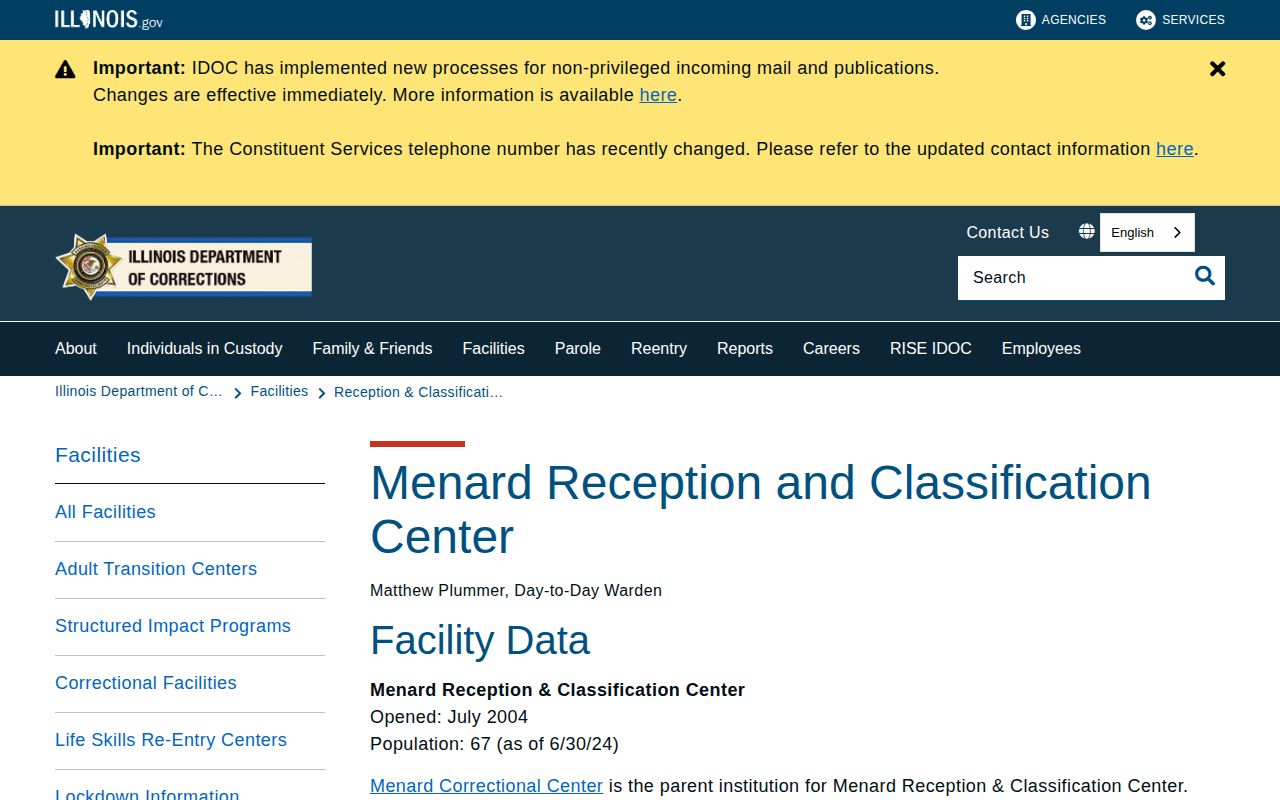
The facility page explains the state placement. A person-specific release or transfer still requires the statewide profile or IDOC record.
Menard Reception Release Dates
Projected Parole Date and Projected Discharge Date answer separate questions. The first estimates when institutional confinement may end in release to parole or MSR under the current calculation. The second estimates when the state sentence or supervision relationship may end. Neither should be relabeled as an accomplished release.
Illinois sentence calculations can change through corrected court orders, verified presentence credit, earned or program credit, disciplinary loss or restoration, detainers, new cases, and supervision violations. 730 ILCS 5/3-6-3 includes offense- and date-specific rules. Some statutory groups have 85 percent, 75 percent, or 100 percent constraints. Illinois does not apply one percentage to every state prisoner.
Reception placement does not itself increase release eligibility. It is an assignment stage. IDOC says Earned Sentence Credit is discretionary and cannot be forecast for a named person. The sound practice is to record projected dates with the retrieval date, wait for the status change, and then confirm the actual event.
Menard Complex Classification History
Menard opened in 1878. IDOC now describes a parent maximum-security prison plus medium-security and reception/classification components on the same grounds. That unusual local structure gives a specific reason to preserve component names in any custody timeline. A person can move a short distance on the complex while remaining fully within IDOC custody.
Reception is intrinsically transitional. The medium unit and parent institution are custody placements after classification or later movement. Their shared address and telephone do not merge their functions. A record that says reception ended should be followed to the assigned institution rather than treated as the end of confinement.
Randolph County Jail is another distinct system. A county detainee transported into IDOC has ended the jail episode without being released into the community. A returned parolee admitted to reception may have left community supervision for state custody. A reception resident placed back on parole/MSR has left the institution but is not finally discharged. These three pathways can all include the word release in casual speech, yet their records are materially different.
Note: Menard's shared campus makes a facility-name change common, so the statewide IDOC status is the key transfer-versus-release control.