
Menard Correctional Center Release Outcomes
Menard Correctional Center is an Illinois Department of Corrections institution. A profile that names Menard as the current location indicates institutional custody at the time represented by the record. If the location later changes to another IDOC prison, the person was transferred within the state system. That is not release to the community.
Parole or mandatory supervised release, often shortened to MSR, means the person left the institution while state supervision continues. Final discharge is different. It marks the end of the sentence and supervision relationship as reported by IDOC. A person can therefore be outside Menard and still remain under IDOC authority for a significant period.
The main evidence is the IDOC status and historical admission, institutional-release, parole, and discharge record. Illinois VINE can alert on a custody change, but it does not replace the originating corrections record. A future date also does not prove that release happened. Confirm the event after IDOC changes the status or supplies an actual dated entry.
Search Menard Release Records
The IDOC Individual in Custody Search is the correct public locator for Menard. Search by IDOC number whenever it is known because that identifier sharply reduces same-name mistakes. Surname, partial surname, and birth date are alternative search fields.
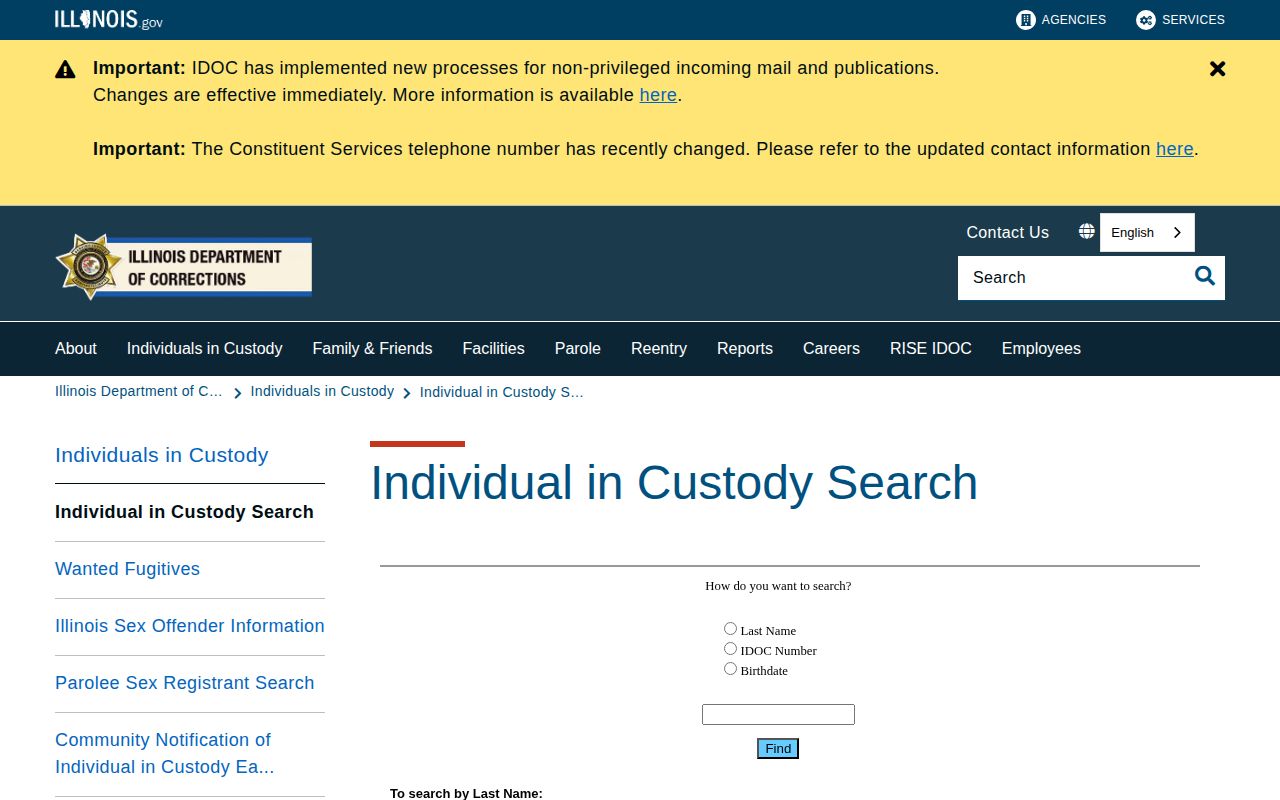
- Enter the IDOC number if available. Otherwise search by surname, partial surname, or birth date.
- Compare identity and sentence details before opening or relying on a profile. A name alone is not enough.
- Read current location or status first. Menard or another institution means custody; parole or MSR means release from prison with supervision.
- Record Projected Parole Date and Projected Discharge Date separately, with the date the profile was accessed.
- Look for a past parole or status field that supports an accomplished event. Confirm it with IDOC or VINE where appropriate.
- If no result appears and full discharge is possible, request historical public information from IDOC.
The broader Randolph County released inmate search explains how county, state, and federal systems differ. For Menard, the sheriff’s roster has no role in proving a prison release unless a separate county jail episode is independently documented.
Read Menard Release Dates
Illinois uses two projected labels that answer different questions. Projected Parole Date estimates when institutional confinement may end and supervision may begin. Projected Discharge Date estimates when the state sentence and supervision relationship may end. Neither field is an accomplished release date.
| IDOC field or status | Meaning | What it does not prove |
|---|---|---|
| Menard location | The profile reports institutional custody at Menard | A future release plan |
| Another IDOC location | The person moved within state custody | Community release |
| Projected Parole Date | Estimated institutional exit to supervision | That the exit occurred |
| Parole or MSR status | The person is outside prison under state supervision | Final discharge |
| Projected Discharge Date | Estimated end of state authority | That supervision already ended |
| Actual discharge entry | IDOC reports the sentence and supervision ended | The details of an unrelated county case |
Projected dates can change because sentence credit is offense- and date-specific, credits may be lost or earned, court records may be corrected, and supervision violations may affect the calculation. Illinois law includes different service rules and exclusions. The broad claim that every person serves the same percentage is not accurate.
If a date matters for a planned event, record its label exactly and confirm after it passes. A VINE notice can prompt a check, while an actual IDOC status or historical record provides stronger evidence. Do not shorten “projected parole” to “released” or attach a final discharge meaning to an institutional exit.
Menard Discharge Search Limits
IDOC says its public information categories can include name, IDOC number, parent institution, current location or status, vital statistics, admission and release dates, and sentencing information for a current or former person. Yet the practical web search returns only people who are incarcerated or on parole. The record channel and the online interface are not identical in scope.
A fully discharged person may therefore produce no web result. That absence does not erase the state custody history or prove any specific date. Ask IDOC for public admission, institutional release or parole, and final discharge dates, along with public sentence information. Identify the IDOC number and preserve the access date and query used.
- Institutional release
- The person left the prison setting, often to parole or MSR.
- Mandatory supervised release
- A required period of community supervision following the prison portion of many Illinois sentences.
- Transfer
- Movement from Menard to another IDOC location while institutional custody continues.
- Final discharge
- The end of the state sentence and supervision relationship, as documented by IDOC.
Menard Records and Contact
The facility can answer institution-specific routing questions, while IDOC’s central contact and records channels handle statewide status and historical public information. Use the IDOC number in correspondence. Questions about parole-agent routing go through the published statewide number rather than an invented local parole storefront.
Menard Correctional Center
Agency: Illinois Department of Corrections
Address: 711 Kaskaskia Street, Menard, IL 62259
Phone: 618-826-5071
Fax: 618-826-1141
IDOC central contact
Address: 1000 East Converse Avenue, P.O. Box 19277, Springfield, IL 62794-9277
Phone: 217-558-2200
Parole-agent routing: 800-666-6744
A disputed Menard location, projected date, release field, or discharge entry should be sent to IDOC with the IDOC number and the contrary primary record. Preserve the original response, screenshot date, URL, and correction correspondence. VINE differences should first be checked against the contributing IDOC record, then raised through the notification support route if the source and alert do not agree.
Menard Correctional Center Facts
The official Menard facility page identifies a maximum-security adult-male institution. It is the parent institution for the Menard Medium Security Unit and Menard Reception and Classification Center, which are separately published IDOC components on the same grounds.
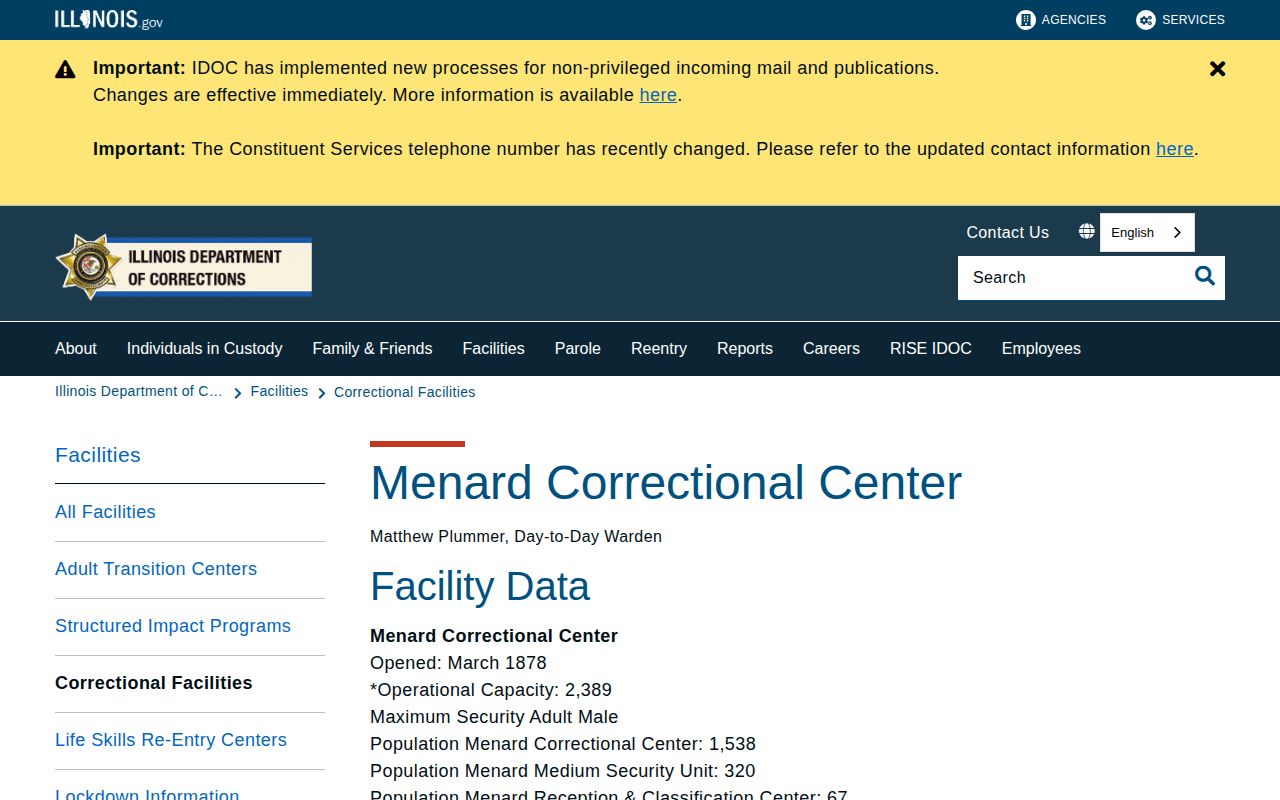
Those figures describe the main institution at the cited reporting point. They do not predict releases or establish the status of a named person. Population and capacity can change. Use the individual IDOC record for a custody decision, and keep the medium-security and reception components distinct when a profile identifies one of them.
Menard Prison History and Structure
Menard opened in March 1878, making its institutional history unusually long. IDOC now describes a parent maximum-security prison with medium-security and reception or classification components on the same grounds. Shared geography does not make every movement between those components a release.
Reception has a transitional classification role. The medium-security unit and parent maximum-security institution are placements within IDOC custody. A move from the parent institution to either another Menard component or another state prison remains a transfer unless IDOC expressly reports release to supervision or discharge.
This structure explains why the full current location matters. A search result should preserve the exact facility or status label rather than reducing every change to “left Menard.” The label determines whether the next check is another IDOC location, the Parole Division, or a historical discharge request.
Menard Release Notifications
Illinois VINE can provide phone, text, email, or mobile-app notice for supported custody events. It is useful before an expected Menard change because the alert can prompt a timely IDOC status check. Registration must be completed before the event, and reporting can lag behind the source system.
IDOC Victim Services provides an alternative registration route. The published contact numbers are 877-776-0755 and 217-558-2200, extension 4006. A notification issue outside business hours can be directed to 866-277-7477. These channels provide notice support, not a substitute decision about what the event legally means.
After an alert, open the IDOC profile and read the status. A different institution is transfer. Parole or MSR is release from prison with supervision. An actual final discharge must be established through the IDOC record. Keeping those categories intact prevents a custody-change notification from being overstated.
Verify Menard Release Evidence
An actual dated IDOC release, parole, transfer, or discharge entry is the strongest institutional evidence. VINE is a useful contemporaneous alert derived from a contributing agency. A current locator is point-in-time evidence, while a projected field is only a forecast. Each source answers a different question.
When sources differ, compare their timestamps and scope. The profile may update after a movement, and a notification may arrive after the IDOC source changes. A court correction can affect sentence data without instantly changing every public interface. Record the exact wording and ask each agency to explain its own field.
Identity controls matter too. Prefer the IDOC number, then compare full name, birth date, sentence details, and facility history. Partial surname search is a discovery tool, not final confirmation. A missing result after possible discharge should lead to IDOC records, not to an unsupported conclusion.